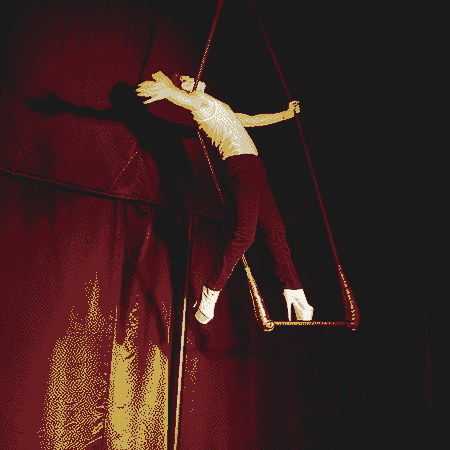
Aerial Attire for Male-Bodied Students (and the Coaches Who Train Them)
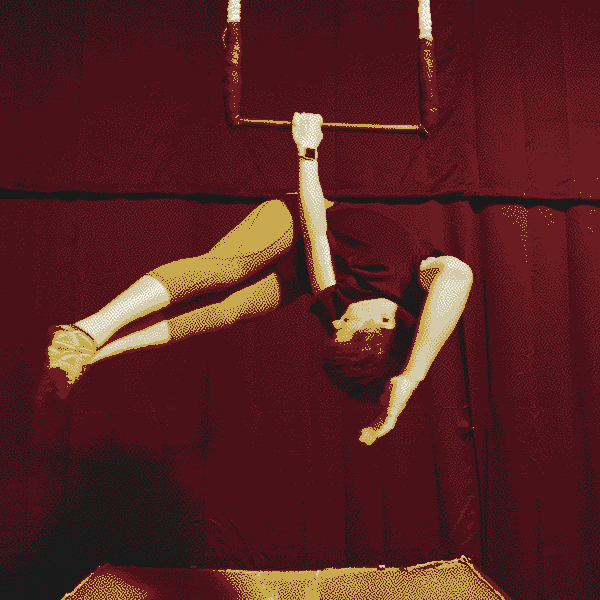
Clothing is one of the things that can dramatically help or hurt your aerial progress. What you wear affects your comfort and safety, and can make certain moves easier or harder. Clothing choices also impact your classmates, audience, and help set the tone for the environment. Different studios will have different HVAC systems and dress codes, so expect some variation in norms. I’ll focus first and foremost on risk reduction for you, the student and performer, but also on safety for your fellow students. I’ll talk a bit about creative artistry too.
Gender is a wide spectrum, and sex is too, so to be clear, this post is directed at aerial students with external reproductive anatomy and the coaches who work with them. The general advice is likely useful for anyone with parts between their legs that they want to protect.
I am a cisgender male circus performer and aerial instructor, trained primarily by an amazing series of female instructors. The challenge of inclusive instruction is relating to students whose bodies are different from yours. What each student needs to be successful is unique. It’s my hope with this article that students can find the advice they need, and instructors can learn how to better support their students.
The safety and comfort of your fellow classmates is also critical to consider. Aerial is an artistic and creative experience. We are inclusive of all bodies and all experiences, and must ensure that our spaces are safe. Male-presenting students must recognize that they are walking into a predominantly female space. You are welcome in this space and your presence can be triggering or threatening to others’ sense of safety. Aerial and Pole can be a refuge and a place to feel strong and sexy for yourself and not for the male gaze. It’s on you to demonstrate that you’re a safe person to be around. This article is about helping you feel comfortable and safe in class, so you can bring your best self.
The Uniform
The basic training outfit is going to consist of a set of basics.
- Top
- Bottom
- Underwear
- Socks
Unfortunately that list is also what I wear to work every day… So what makes aerial different?
Tops
A t-shirt is fine. Because this is an athletic activity and you’re likely to sweat, an athletic shirt made of synthetic material (not cotton) will probably serve you better. Your shirt can be tight or loose, but you’ll find that a tighter top is less likely to snag on the apparatus. Avoid anything excessively baggy and be sure to tuck your shirt in before inverting — the last thing you want to do is have to pick between tugging your shirt down and holding on to the apparatus.
Consider apparel that protects your armpits, and perhaps the inside of your elbows. Sleeveless shirts can be okay for some apparatuses and routines, but check your studio’s dress code. Wiping your sweat and deodorant on the ropes or fabric is an unsanitary faux pas, so keep your pits covered in class.
My go-to is polyester athletic t-shirts, cotton if it’s cooler and I’m less likely to sweat. When it’s especially chilly, I’ll wear a thin long-sleeve athletic top.
Bottoms
Your bottoms also aim to strike a balance between safety, comfort, and aesthetics. Protecting the backs of your knees and insides of your thighs is very important. Loose pants can wrap around trapeze and lyra bars or get pinched in fabrics. You don’t want your pants pulled down as you perform a move. Tight leggings will generally glide on the apparatus and allow freedom of movement.
Dark, thicker, yoga pants are my preference, and I personally wear women’s — men’s leggings and tights tend to be shinier with distracting stitching. Because I wear a dance belt, I don’t find any sort of “pouch” design to be necessary. Some leggings can be quite see-through when stretched. You can test in-store by stretching over your hand. For online shops, check the reviews to make sure they are “squat proof”.
Wearing athletic shorts is another option. The risk of snagging increases, so I recommend both leggings and shorts. Shorts over leggings also adds a second layer of fabric that can slide more freely — the layers move against each other rather than the apparatus moving against your skin, which can reduce friction on moves where fabric or a bar needs to travel. The tradeoff is more material to manage, and loose shorts can still catch or bunch. Shorts are necessary if you aren’t wearing a dance belt or other compressing underwear.
Underwear
This is where we get more anatomically specific. I strongly recommend a Dance Belt for both safety and aesthetics. The compression helps keep things tucked in and avoid pulling and pinching. The thickness of the fabric helps smooth and avoid lumps and lines. It’s not a hard plastic athletic cup like you’d find in other sports, so it won’t provide complete protection, but it will keep your parts in a predictable spot so you can learn how to adjust your movements appropriately.
This isn’t just an issue for your own safety. Nobody in class wants to see your parts. If you want to wear tight-fitting leggings or bodysuits, which are great for aerial, you need to wear a dance belt.
There are typically two styles - thong and full-seat. Which you choose is a mix of comfort and appearance. Thong style will hide panty lines and odd compression on your buttocks. Full-seat style is more comfortable for most folks, especially if the idea of “butt floss” makes you flinch. Either style does what it needs to do in the front.
They also often come in two colors - black and nude. Nude is the better choice if your outer layer is semi-transparent and you want to avoid the “shadow” of dark underwear.
For sizing, if you know your size in women’s yoga pants or leggings, it’s probably the same. I have a 31" waist and wear a Medium Capezio dance belt. Other brands may have slightly different sizing.
The last thing to know is how to wear them. Once you pull them on, you want to lift and point your parts upwards. This keeps things out from between your legs and further avoids pinching. Another trick I’ve found handy is to pull long tops down over my dance belt, and then lightly tuck my shirt up under the waistband on the sides — this keeps my shirt from coming untucked far better than my legging waistband alone.
Socks
Socks are generally optional. On fabrics, socks are often too slippery. On steel, they can provide some useful protection. You’ll see some people using leg-warmers for warmth that doesn’t sacrifice grip.
Other Items
Trapeze boots - Trapeze boots are essentially armor for your shins and the tops of your feet. They help with certain moves, and while I love performing in them, I train without them so I don’t rely on them.
Watches and jewelry - Don’t wear them, especially if there are any sharp edges. On Trapeze and Lyra I can get away with an Apple Watch because it’s smooth - but on fabrics it can squeeze and hurt, or worse activate the SOS button.
Costumes - Masculine costumes and costumes for male anatomy are hard to find. Black leggings work fine, and I’ve even performed in stretchy skinny jeans (I don’t have a wide split, so I’m not worried about tearing out the crotch). The most important thing when it comes to costuming is to practice before you perform! You will likely need to tweak your routine or costume once you actually put them together.
For Coaches
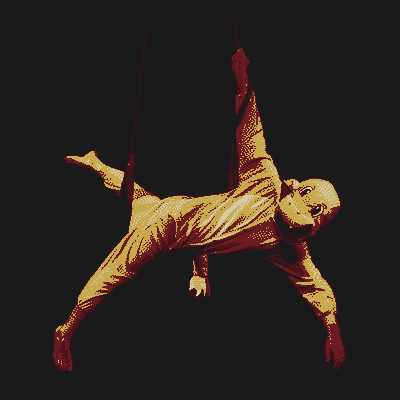
Most of what’s in this guide is things your male-bodied students need to know before or during their first few classes — and things you may not have had to think about if your own body is different from theirs. Your job isn’t to have all the answers, it’s to make sure students aren’t figuring this out alone mid-class.
In your dress code. The clearest way to set students up for success is to address attire before they walk in the door. A dress code that mentions dance belts or compression underwear for students with external anatomy means you don’t have to single anyone out — it’s just policy, not a personal comment.
During introductory classes. A brief orientation moment at the start of a first class — covering what to wear, what to avoid, and why — normalizes the conversation for everyone. Don’t make assumptions about who needs this information based on how someone presents or what pronouns they use; share it broadly and let students self-select what applies to them. It’s also a good time to let students know they can come to you with questions privately.
After class, if needed. If a student shows up underprepared — loose shorts, no compression, sleeveless in a fabric class — a quick, matter-of-fact conversation after class is usually the right move. Keep it practical and solution-focused: here’s what to get, here’s why it’ll help. This guide exists partly so you can point them somewhere concrete.
On certain moves. This guide doesn’t cover specific technique, but it’s worth knowing that attire only goes so far. Moves where a bar or fabric travels from the thighs up toward the stomach, or from the inside of one thigh up and over to the inside of the other, are a different physical experience for students with external anatomy — even with a dance belt. If you haven’t coached many students with this anatomy, assume there’s a learning curve on both sides. Check in, be matter-of-fact about it, and give students room to adjust without making it a bigger deal than it needs to be.